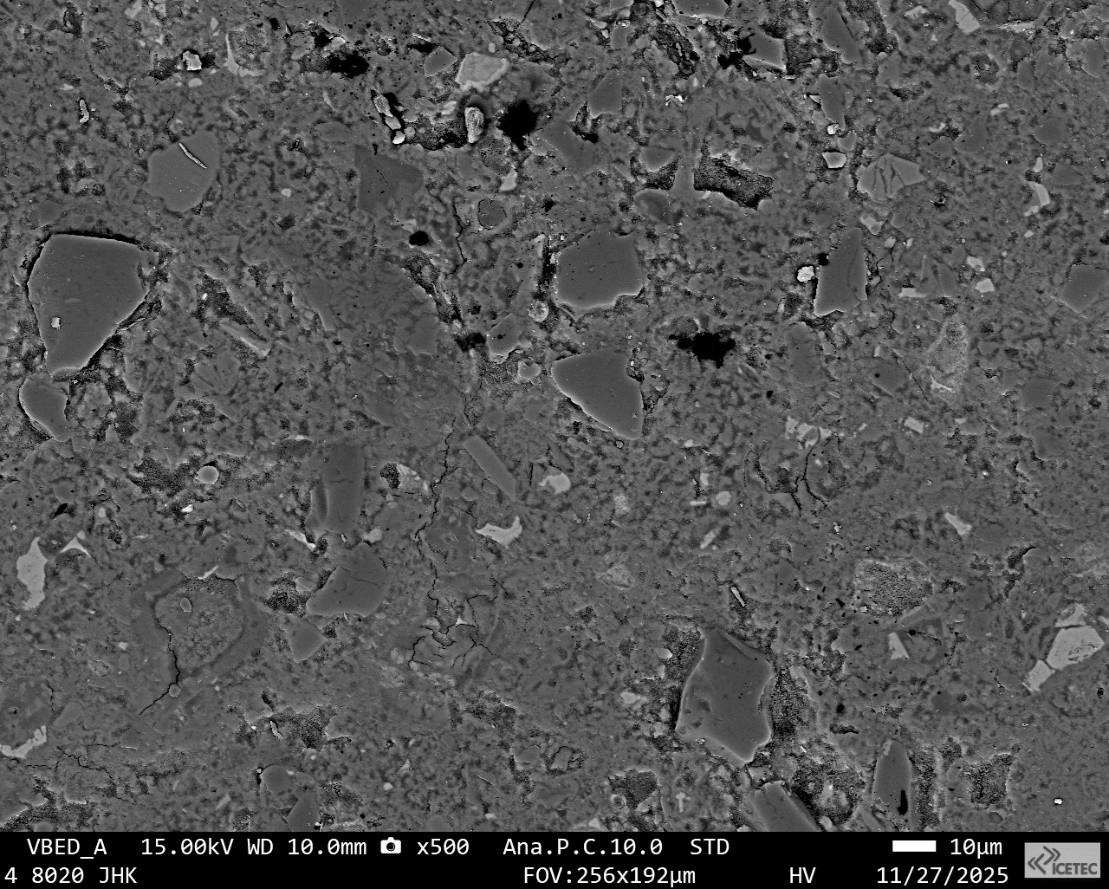
Practical Assessment of Environmentally Friendly Concrete under Icelandic Conditions
Description
The project is categorised under the field of construction materials, but its focus is equally on CO₂ emissions and technological innovations in civil engineering that reduce environmental impacts while ensuring the durability of concrete structures.
The aim is to reduce the cement content in concrete by using various supplementary materials as partial replacements for cement. This would help reduce CO₂ emissions from the construction industry, as cement production is a major source of CO₂ emissions.
Icelandic building regulations stipulate a minimum cement content of 300 kg/m³ for external concrete and 350 kg/m³ for external concrete exposed to severe weathering conditions. The aim of this project is to investigate whether, and to what extent, cement consumption can be reduced without compromising the properties of concrete, particularly its strength and durability.
In this context, it is worth noting that the building regulations are currently undergoing regular review, including provisions concerning minimum cement content, freeze-thaw testing of concrete containing fly ash cement, and whether activity coefficients and corresponding values should be permitted. Concrete containing fly ash cement generally does not pass the freeze-thaw resistance test as currently defined in the building regulations.
To reduce the cement content in concrete without compromising its properties, the volume of cement paste must remain unchanged. This will be achieved by compensating for the reduction in cement with a finely ground supplementary material. The supplementary material must be ground to at least the same particle size as cement. Finely ground Icelandic basalt is worth highlighting in this regard, as it has favourable properties for use as a concrete additive and has a very low carbon footprint.
The project addresses two research questions. First, to what extent can the cement content in concrete be reduced by using supplementary materials as replacements without compromising quality and durability? Second, how much can the carbon footprint of such concrete be reduced?
The success of the project will be evaluated based on the answers to these questions. The final outcome will be a durable C30-grade concrete containing approximately 160 kg of cement and 160 kg of supplementary material per cubic metre, instead of the conventional 320 kg of cement per cubic metre.
Our Role
Acknowledgements
The project is funded by HMS Askur – the Construction Industry Development Fund – together with in-kind contributions from the other project participants.
Timeline
Jun 2026 – ongoing
Partners
- Dr. Ólafur Sveinn Haraldsson, Vegaerðin og Háskóli Íslands
- Einar Einarsson, sjálfstætt starfandi ráðgjafi
- Dr. Sigríður Bjarnadóttir, BM Vallá/Hornsteinn
- Eggert Guðmundsson, Vista Verkfræðistofa